

fragmentology
A not-so-fragmented piece of writing to celebrate fragments.

This is part 1 of a in-the-works series on personal essays. Stay tuned for upcoming installments!
“…with the fragment as with the essay itself, there is this ambiguous shuttle between identity and dispersal, between formal, almost physical integrity and a fracturing or even pulverizing action.” Brian Dillon, Essayism
There’s a field of study called “fragmentology” that studies, well, fragments. Of manuscripts, that is, of medieval manuscripts from the Middle Ages. Despite all the loss and destruction and the centuries of material decay, these pesky things have a habit of dying hard. Good parchment can be very resilient, and you’d be surprised with the amount of pages that have found their way into the binding of later books, to mention just one of the most common places where these pieces come up (though one of my favorites usages is inside mitres, like bishops’ headgear). Then in the so-called modern age, fans of medieval illuminations thought “wouldn’t it be just easier if we kept the pretty pictures and didn’t bother with the rest?” and started cutting up manuscripts. I kid. Sort of. I hope you will allow me this oversimplification for the sake of not getting down to nitty-gritty of something that isn’t even the main topic of this essay. I’ll leave you with a link at the end, if you want to follow this rabbit hole.
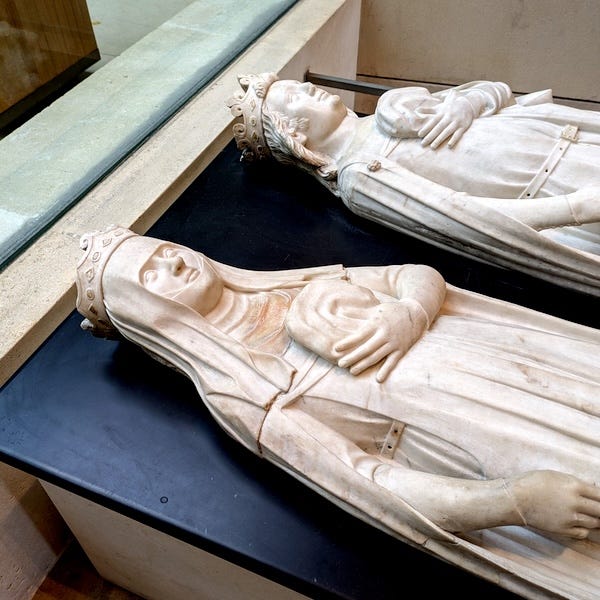
Anyway, the value of studying manuscript fragments comes from both their idiosyncrasies and what they have to say about the whole they come from. Although I dabbled on manuscript fragments on occasion, the type of fragment I was really interested in back in the day was of the bodily type. Did you know medieval queens and kings sometimes decided on having their bodies divided and buried in different places? This place got a heart, that other the entrails, and finally a third one got the body. Pope Boniface VIII didn’t care much for the practice and tried stopping it, then Philip IV of France got really into the idea and decided he didn’t much care for Boniface, and the rest is (French) history. In any case, Boniface’s prohibition didn’t stick with the French royals and some of their peers. Anne of Brittany (1477–1514) heart is probably the most famous example of this type of burial, and I could talk a whole lot more about previous examples (which I have but I won’t here).
This is all to say that: I’ve thought of fragments before. If I wanted to sound really academic, I could even say I have thought with fragments before. Over the years, I have developed a habit of looking for them, of trying to see patterns when I do spot them, and overall just mentally collecting the ones I find meaningful somehow. I’ve come to realize that I most often think in fragments, ideas coming to my mind in quick bursts, in these snippets that are both half-formed and complete. I like short stories. I like novellas over long novels. I prefer the short and meaningful to the long and drawn out. When writing my dissertation, I struggled for months (okay, years) before I realized that I needed to break down (long) chapters into (bite-sized) segments that could then be strewn together into a more coherent piece. Despite all my resistance to the very idea of outlining, it was breaking down chapters into sections into paragraphs that got me through the finish line. Almost four years after said line, I can look back and feel like I have learned some lessons. Not all. You will still find in my computer and phone several false starts, some of those half-formed snippets that I wish I could turn into fuller texts but that feel complete enough as they are. I know they aren’t. But I don’t fight against the inertia as strongly as I should, and so they stay as they are. Incomplete. Unpublished. Unshared.

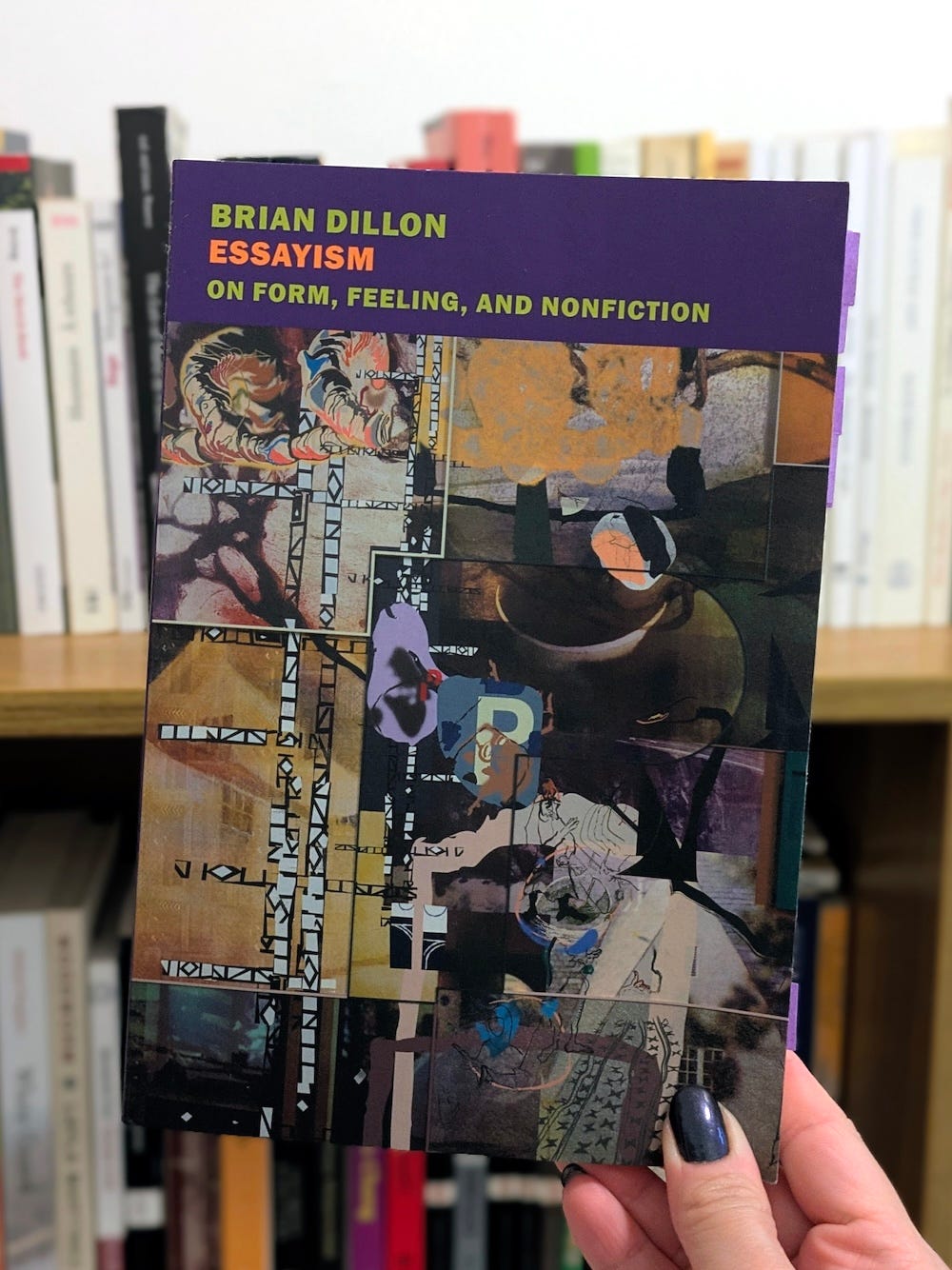
I found some solace in Brian Dillon’s Essayism, a collection of short essays on the essay, a genre I have been drawn to lately (enough to even call this missive an “essay,” if you caught it above). I was expecting any type of comfort when I first started reading it, but it build up through its pages, almost unexpected. Certainly unannounced. I am firmly against the notion that nonfiction (or literature in general) should be read exclusively for its practical solutions and effects, but sometimes it so happens that affects are touched. One of the advantages of reading and writing outside academia is letting that happen earnestly rather than try and hide it behind any contribution to the field (except for: the field is me, my brain, let others enrich this soil and see what blooms).
“Imagine a type of writing so hard to define its very name should be something like: an effort, an attempt, a trial. Surmise or hazard, followed likely by failure,” Dillon says in the opening essay, trying to define the genre. And then later: “Essayism is tentative and hypothetical, and yet it is also a habit of thinking, writing and living, that has definite boundaries. It is this combination that I am drawn to in essays and essayists: the sense of a genre suspended between its impulses to hazard or adventure and to achieve form, aesthetic integrity.” The giddiness that comes from stumbling upon a description of the mode of writing I aspire to, I should say, is quite indescribable. Like coming across an old friend you just met, that feeling of acknowledgement and realization all rolled into a flash of surprise.
But more so than essays, I would describe myself as a writer of failures. Psychologically, you can attribute it to my anxiety and perfectionism. Astrologically, to me being a Gemini. I have collected false-starts over the years, many of which just sit there, waiting for “the right day” or “more research” or… You get the gist. Even the ones I know will go nowhere, I cannot bring myself to delete. I’m also a hoarder, you see. Along with these false starts, you will also find dozens of files of dumped material from my dissertation, phrases or paragraphs or pages I pulled from chapters but could not bring myself to erase entirely, “just in case”.
My antilibrary extends from my physical shelves into my virtual folders of e-books and articles I may, one day, feel tempted to read. Yet it’s the false starts that always make me pause and reconsider my archivistic choices. Do I keep them because of their potential or because I can’t let go? I would like to believe it’s the former. Beginnings hold this amazing power: promise. Endings require fulfillment, if not closure; realization, if not wholeness. You get excited when you get an idea and write it down; I’ve yet to feel the same way about putting the final stop. Roland Barthes, says Geoff Dyer, “liked to ‘write beginnings’ and multiplied this pleasure by writing books of fragments, of repeated beginnings.”
I like small things. Little trinkets. Short books. Twist ties from the packaging of loaves of bread.
And isn’t the fragment a small thing? A textual trinket? I like to think of it as a little ornament that sits on my mind’s shelf. One that I can then pick up and offer to a reader, who can then add it to their own shelves. Pass it along. Toss it aside. Break it into smaller bits and pieces, to mix and match. It’s yours now too.
Links:
The journal Fragmentology focuses on manuscript fragments and is fully open access. You can check it out here.
You can seem some types of manuscript fragments, including the reuse in a bishop’s mitre, on The Arnamagnæan Institute’s website (University of Copenhagen).
The Wikipedia page for Anne of Brittany’s heart jewel case is pretty good and has a very nice photo of said case.
Boniface VIII’s 1299 decretal against the division of corpses for burial, called Detestande feritatis after its first two words, is fully available online in the original Latin.
Brian Dillon’s quotes come from Essayism: On Form, Feeling, and Nonfiction. Geoff Dyer’s quote comes from his foreword to Roland Barthes’s Camera Lucida: Reflections on Photography (trans. from French by Richard Howard).
I am adding Essayism to my March TBR! Recently, I have been obsessed with novellas, articles and essay collections. What gave me permission to write in a similar, bite sized way was reading Clarice Lispector’s Crônicas. This piece really interested me because I had never heard of fragmentology before. I loved your take on this and the essay as a mode of writing, I can’t wait to read Essayism!
I love your notion of fragments of text that seem to be incomplete but which don't seem completable. A beutifully indeterminate, almost quantum state to be in!